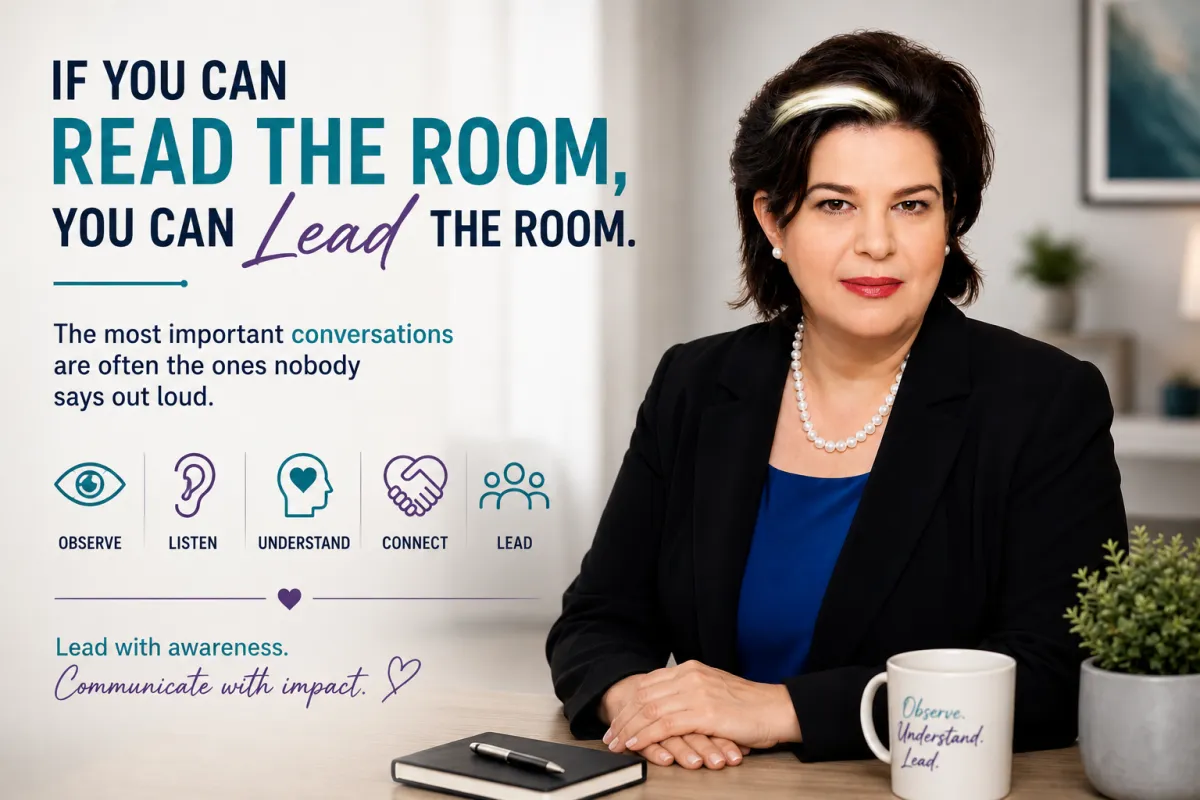
If You Can Read the Room You Can Lead the Room- Copy
One of the most valuable lessons I learned while becoming a certified Body Language Trainer and Micro-Expressions Expert was that:
People will tell you who they are long before they tell you with words.
Most people enter a conversation focused on what they want to say next.
After all, the human mind processes information much faster than we can speak, which means we're often preparing our response instead of truly listening.
As a result, many conversations become less about understanding and more about waiting for our turn to talk.
Great communicators do the opposite.
They observe.
They listen.
They become curious.
Observation Is One of the Most Powerful Communication Skills
Over the years, I discovered that one of the greatest communication skills isn't speaking.
It's observing.
When I meet someone, I spend much of my attention listening, observing, and becoming curious about what is happening beneath the words.
Notice I didn't say judging.
Observation and judgment are not the same thing.
Judgment jumps to conclusions.
Observation gathers information.
Curiosity creates understanding.
That distinction is what separates great communicators from average ones.
It means paying attention.
Great communicators understand that communication is much more than language.
It is the tone of voice.
It is the pace of speech.
It is facial expressions.
It is posture.
It is gestures.
It is eye contact.
It is emotional congruence.
Over the years, I discovered that the more time I spent observing and listening, the more people revealed about what they were truly thinking and feeling.
In many conversations, I spend about 80% of my attention observing, 80% of my attention listening and only 20% speaking.
People reveal themselves through their behavior.
A slight tightening of the lips may signal disagreement.
A sudden drop in eye contact can indicate discomfort.
A shift in posture may reveal uncertainty.
A change in breathing can reveal stress.
Research consistently shows that much of emotional communication is conveyed nonverbally. While words matter, facial expressions, tone of voice, posture, and body language often reveal what people truly think and feel.
Your Body Is Always Speaking
One of the biggest misconceptions about body language is believing that a single gesture tells the whole story.
It doesn't.
Context always matters.
This is why establishing a person's baseline is one of the first things I teach.
We observe how someone naturally when they are not stressed. Once you know someone's baseline, small changes begin to tell a story.
For example:
A slight tightening of the lips may suggest disagreement.
A sudden drop in eye contact can indicate discomfort.
A noticeable shift in posture may reveal uncertainty.
A change in breathing can signal stress or increased emotional arousal.
None of these behavior's should ever be interpreted in isolation.
Instead, they invite curiosity.
Something changed. Now it's time to understand why.
Great Leaders Read Patterns, Not Just People
The best leaders aren't mind readers.
The best leaders, managers, and team members don't just hear words.
They're pattern readers. They recognize when someone's behavior changes.
They recognize emotions, and notice when confidence drops.
They respond with empathy,
Because empathy builds trust.
Trust builds rapport.
Rapport builds influence.
They sense when enthusiasm disappears.
They see when someone wants to contribute but hesitates.
Most importantly, they create an environment where people feel safe enough to speak honestly.
Leadership isn't about having all the answers.
It's about asking better questions because you've noticed something others missed.
Curiosity Builds Trust
One of the greatest gifts you can give another person is your full attention.
When people genuinely feel seen and heard, something remarkable happens.
Trust begins to grow.
Empathy replaces assumptions.
Conversations become deeper.
Relationships become stronger.
Teams become more connected.
Trust doesn't develop because we have all the right words.
Trust develops because people feel understood.
If You Can Read the Room, You Can Lead the Room
Whether you're leading a meeting, negotiating with a client, interviewing a candidate, coaching a team member, or simply having dinner with your family, observation is one of the most underused leadership skills available.
The people who create the greatest influence aren't necessarily the loudest voices in the room.
They're often the ones paying the closest attention.
They notice what others overlook.
They hear what isn't being said.
They recognize emotion before conflict arises.
They respond with empathy instead of assumption.
And that changes everything.
A Challenge for Your Next Conversation
The next time you're in a meeting, try something different.
Speak a little less.
Observe a little more.
Become curious before becoming certain.
Listen with the intention of understanding rather than replying.
You may discover that the most important conversation happening in the room is the one nobody is saying out loud.
I'd love to hear from you.
What's one nonverbal signal you've noticed in a meeting—or even in everyday life—that told you more than the words being spoken?
Share your thoughts in the comments. Let's start a conversation about the silent language we all speak every day.
To know more how body language can help you go to: https://elenapetrescu.com/body-language-trainings/


